In Umbria, along the Romea Germanica Road - Cammini d'Umbria

Via Romea Germanica
Stages of the Via Romea Germanica in Umbria
Via Romea Germanica
The Via Romea Germanica, with its 2,200 kilometres, is a historic and cultural route of European interest. In the Middle Ages, it was an important road axis connecting the North Sea with Rome: it starts from Stade, in Germany, crosses Austria and reaches Rome in 94 stages, 46 of which are in Italy. In 1236, the Benedictine monk Albert undertook this long journey and described his return route as the melior via — the best route.
The 4 Umbrian stages, which cross the region on its western side, form an itinerary with no particular difficulties, winding through one of the most characteristic areas of Umbria.
During the first stage, views of gentle hills cultivated with olive groves and vineyards alternate with glimpses of Lake Trasimeno and Lake Chiusi. Along one stretch, the route skirts archaeological excavation areas, such as the Etruscan Tomb in the Paradiso locality, which can be visited, along the municipal road of Vaiano, near Villastrada. It then passes through charming historic centres with numerous points of interest, including Paciano and Allerona, listed among the Most Beautiful Villages in Italy, Città della Pieve and Ficulle.
Finally, the route ends beautifully by passing through Orvieto, whose remains bear witness to the city’s cultural importance within the Italian historical and artistic panorama, and reaching Porano. Before entering Lazio, the route passes by the “Hescanas” and “Golini” Etruscan Tombs, which can be visited and are unique in Umbria for preserving original 4th-century BC paintings in situ.
Further information at www.viaromeagermanica.it
35. Umbria
36. Umbria
37. Umbria
38. Umbria
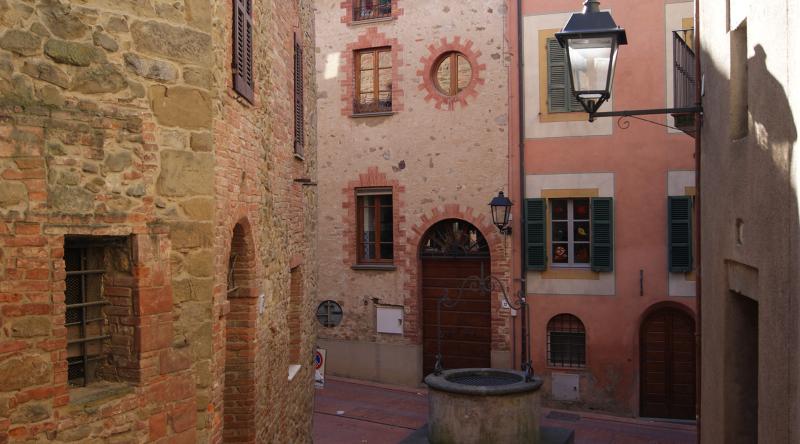
The first Umbrian stage of the Via Romea Germanica starts from Pozzuolo and follows a section that runs partly along roads and partly across gentle hills cultivated with vineyards, offering views over Lake Chiusi and Lake Trasimeno. The route passes alongside archaeological excavation areas where Etruscan tombs have been discovered, with explanatory panels available along the way.
The itinerary crosses the villages of Gioiella, Vaiano and Villastrada, where it is possible to admire a ceramic mural depicting the Via Romea along Lake Trasimeno. The route then continues towards Cantagallina before finally reaching Paciano, a town listed among the “Most Beautiful Villages in Italy,” which is accessed through Porta Fiorentina.
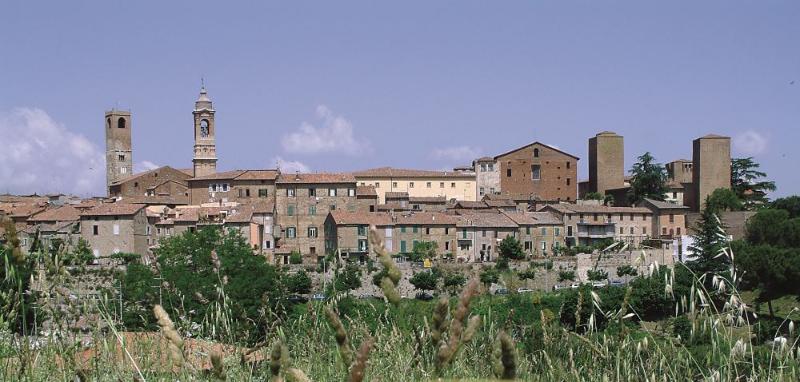
The stage begins in Paciano, a village well worth visiting for its characteristic historic centre, its churches housing important paintings, and the noble Palazzo Baldeschi, home to the TrasiMemo Museum. Leaving the village through Porta Rastrella, the route winds through the mid-slope woodlands of Monte Petrarvella.
During the stage, the route passes through the settlements of San Donato, Popoltaio-Schiacciato, Valdilucciole and Casaltondo, where a fountain is available for refreshments. After a short stretch along a provincial road, the itinerary continues on unpaved roads, crosses a stream, and finally reaches Città della Pieve.
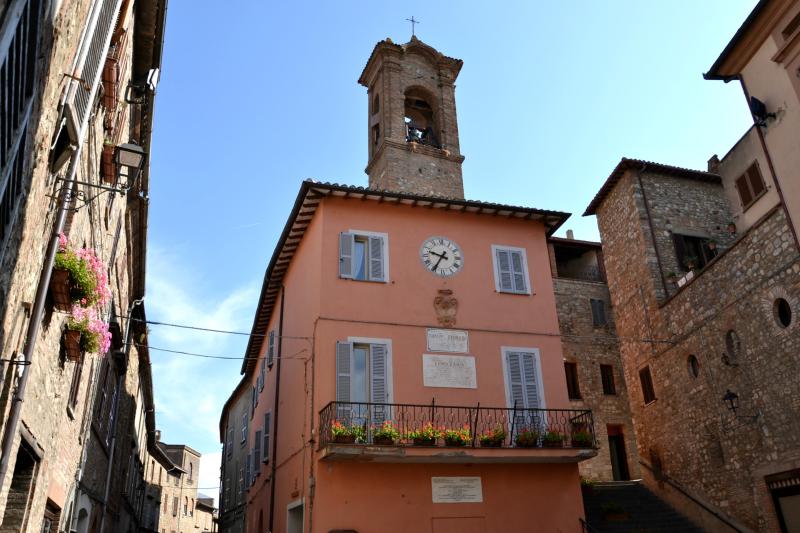
Leaving behind the charming historic centre of Città della Pieve, the route descends towards the valley of the Chiani stream and, passing through the village of Santa Maria, reaches Fabro Scalo.
From here, with a short detour, it is possible to climb up to the Rocca di Carnaiola, whose castle dates back to the year 1000. The itinerary then continues, crossing the stream and skirting a wooded area until reaching Ficulle, a typical medieval village where the castle and churches are certainly worth a visit.
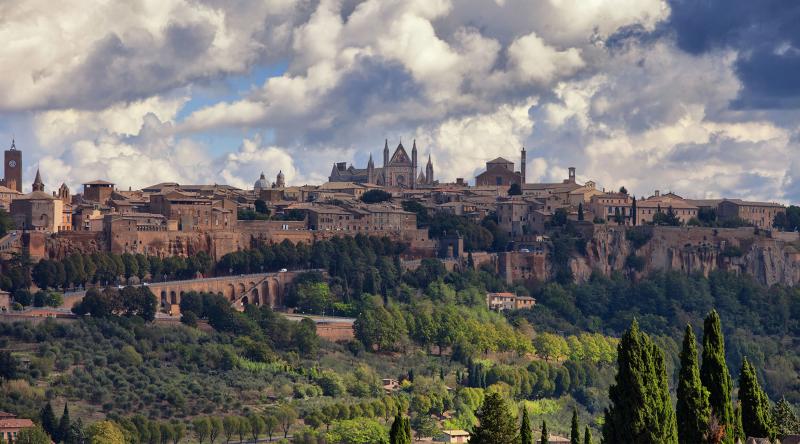
With this stage, the Via Romea Germanica leaves the Umbria region and heads towards Lazio along a route that is slightly more demanding than the previous stages. After leaving Ficulle behind, the itinerary continues to Allerona Scalo. The route then crosses the Paglia River, along which the remains of the ancient Ponte Giulio can still be seen.
Upon reaching Sferracavallo, the silhouette of Orvieto Cathedral already appears in the distance. In less than two kilometres, the route reaches the historic centre of this remarkable town, where the stage concludes.
Elevation gain
+1904 m | - 1949 m
Distance
90,41 km
Duration
21 h 5 m
Historical Notes
The Abbot Albert, while he was at the Benedictine Monastery of the Blessed Virgin Mary in Stade (Hamburg), recognized the necessity to adopt a more rigid ecclesiastical discipline, according to the model of Cistercian rules.
Since he had to obtain the permission by Pope Gregory IX for that purpose, he started his journey towards Rome. The Pope gave his approval to the wished reform, but the Brothers and the Archbishop of Bremen refused it. Disappointed, Alberto resigned from his position and entered the Convent of Friars Minor in San Giovanni (Stade).
Here he dedicated himself to writing the so called Annales, a Latin chronicle of the main ecclesiastical and political events of his time.
In this work you can find the dialogue between two monks concerning the best ways for a pilgrimage towards Rome. In the dialogue, the Abbot points out different itineraries with precise data on places and distances to cross, on the conditions of roads and exact indications on the length of the individual stopovers in German miles.
The itinerary
The path, about 2200 km long, has been rediscovered thanks to the work of passionate scholars and archaeologists.
It is made up of three main sections: Germany (from Stade to Wernigrode through Saxony, Thuringia and Bavaria). Austria (Seefeld - Innsbruck- Brenner) and Italy.
The Italian itinerary covers 1000 kilometres (divided in 46 stopovers) from Alps to Rome and crosses inspiring views immersed in the nature, villages and towns rich in art and history, through both internationally famous places and less known Italian corners.
The Itinerary can be covered on foot, by bike, on horseback, but also by car and motorbike, choosing from time to time the favourite stopovers to cover with calm and tranquillity, based on the available time and abilities.
There are four Umbrian legs: from Pozzuolo to Paciano (21 km), from Paciano to Città della Pieve (15.6 km), from Città della Pieve to Ficulle (21.7 km), from Ficulle to Orvieto (24.8 km).
It’s a journey at the discovery of some historic and artistic jewels of the Green Heart, among ancient testimonies and landscape beauties.
The Umbrian section of the Via Romea Germanica has a total length of 82.41 km, to which the 8 km stretch from Orvieto to Porano are added. On the official Via Romea Germanica website, this stretch is included in stage 39, marking the passage from Umbria to Lazio.
The Pilgrimage Credential
To follow the Itinerary, request the Pilgrimage Credential allowing to access “ospitali” (pilgrims' lodging) and to obtain some discounts. The Credential carries the place and date of departure and arrival, the stamps of the places and of the accommodation structures visited, as a demonstration of the path travelled.
The Credential is also the document needed to obtain the certificate of pilgrimage completion, once arrived in Rome, the "Testimonium”.