
Trekking on the Nera Greenway from Sant'Anatolia di Narco to Ceselli

Trekking on the Nera Greenway from Sant'Anatolia di Narco to Ceselli


-
Positive height difference : + 40 m
-
Negative height difference : - 30 m
Easy hike. Suitable for all levels of fitness. Easy trails. Suitable for all levels of ability.
At the town hall of Scheggino, section 4 of the Greenway begins. The itinerary continues along artificial channels called “gualchiere” or “valchiere”, once linked to the production of woollen cloth.
Beside these channels, on the right, is a pedestrian bridge over the Nera River that leads to Piazza C. Urbani. It is worth a short detour to visit the Museo del T
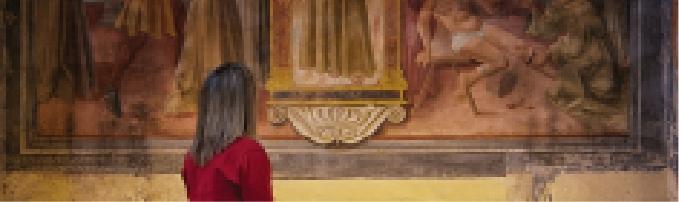
To the left is the historical centre of Scheggino with its steep stone alleys and its church of San Nicola, whose frescoes were commissioned by the people of Scheggino to Giovanni di Pietro known as Lo Spagna.
Continuing along the “gualchiere” and passing the remains of an old mill on the right, we come to the medieval gate of the village, marking the end of this urban section of the route. Here begins a dirt path, which is flat and without any significant difficulties. After about 3.5 km, you reach Osterie di Ceselli, marking the end of section no. 4 of the Greenway and the route.
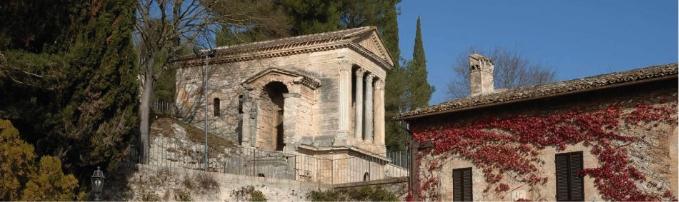
From here, by crossing the junction with Provincial Road 209, you can glimpse the Romanesque church of San Vito and enter Ceselli, a hamlet dominated by the church of San Michele Arcangelo, built in the 14th century using the polygonal tower of the keep, later transformed into a bell tower, as an apse.
-
Positive height difference : + 70 m
-
Negative height difference : - 60 m
Easy hike. Suitable for all levels of fitness. Easy trails. Suitable for all levels of ability.
The itinerary starts from the locality of Palombara (the beginning of section 5 of the Green Way of the Nera River), named after ancient “palombare” towers used for raising pigeons and collecting guano, a precious fertiliser used for the cultivation of hemp, which mostly took place in the land near the river, still called “canapine” (hemp fields), in the direction of Scheggino.
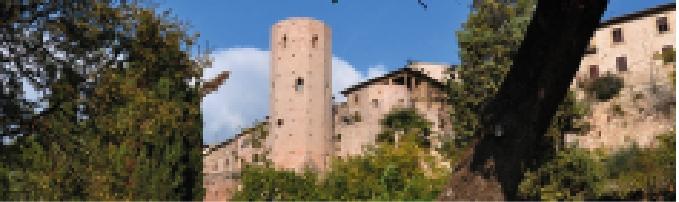
Upon reaching the fountain, where it crosses a path leading to Castel San Felice, the surface turns to dirt for a short stretch. A scenic uphill section runs along the medieval walls of Sant’Anatolia di Narco, offering wonderful views of the landscape below.
At the top of the climb there is a notable piece of street art: “Biosintesi di un pensiero elettrico” (Biosynthesis of an electrical thought), created in 2021 by artist Giulia Buonanno on the Enel cabin.
A little further on, you can admire the church of Santa Maria delle Grazie, which houses frescoes by the Master of Eggi and a group of wooden statues called “I Dolenti” (the mourners). One of the three statues, a crucifix, is attributed to Sangallo. The church is located in Piazza Corrado, outside the medieval walls of Sant’Anatolia di Narco.
With a short detour through the city gate, visitors can explore the historical centre, laid out according to the medieval castle’s structure, and the Museo della Canapa (Hemp Museum). Opened in 2008, the museum showcases the history of hemp cultivation and its modern uses, including the textile art installation “Spinning Dolls” by artist Liliane Lijn. Additional exhibition spaces throughout the historic centre reveal more about the hemp farmers and weavers in Sant’Anatolia di Narco.
Returning to Piazza Corrado, the trail resumes along section no. 5 of the Greenway. The route continues past the former Convent of Santa Croce, built in the 13th-14th century as a Franciscan convent of the Minor Observants.
Leaving Sant'Anatolia di Narco, the route continues on a dirt path through a wood towards Scheggino. At the church of San Rocco, you can either cross the road (Via del Borgo) and walk to the town hall of Scheggino, or take a detour to visit the Valcasana springs before reaching the town hall.